repair · Aug 19, 2026
A Repair Café That Actually Works
Eighteen months into running a monthly repair café on Linden Row, here is what kept it alive: a good kettle, a sign-in sheet, and a rule about never fixing alone.
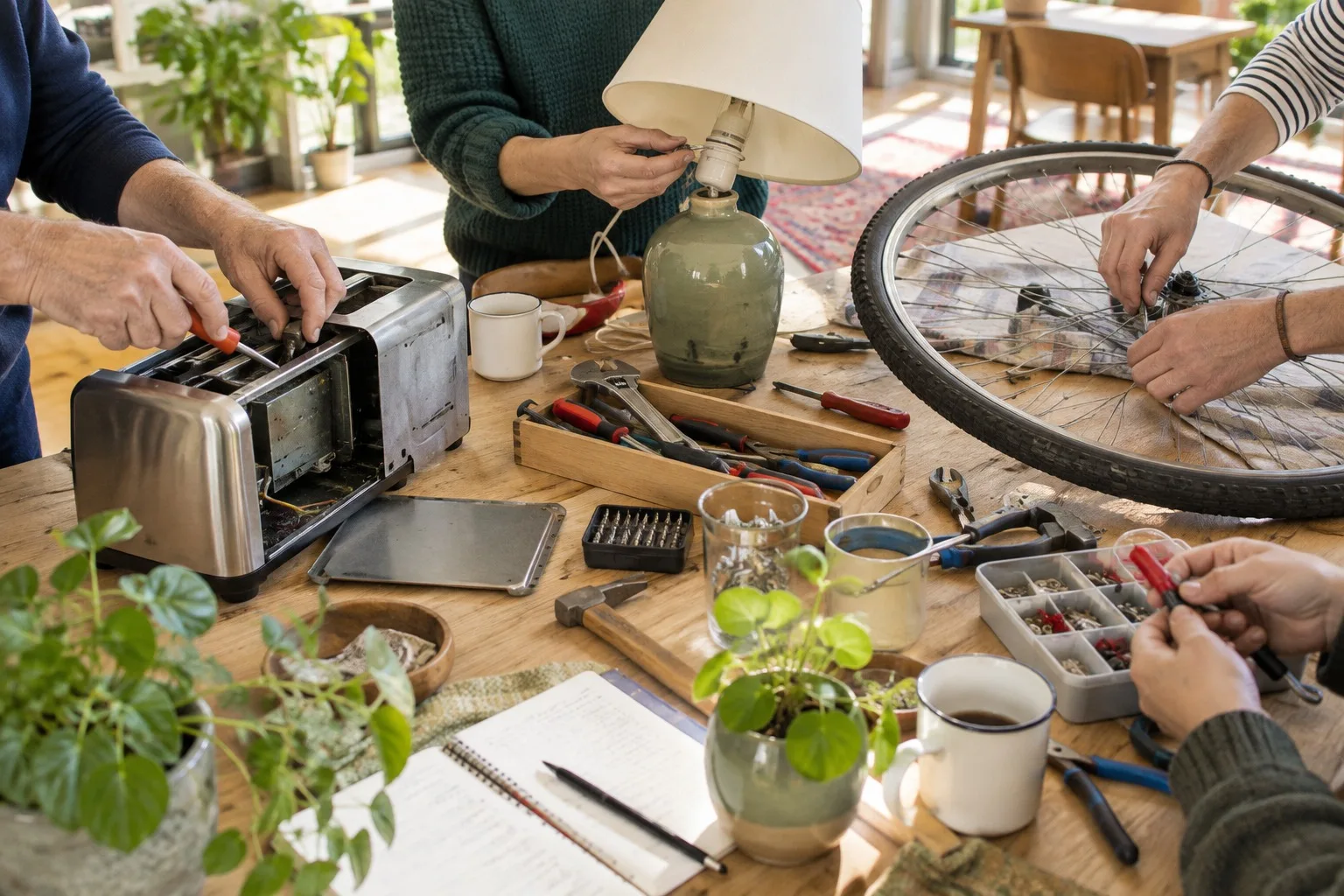
Our repair café is called Mend & Kettle, and it's open the first Saturday of every month in the back hall of the Linden Row community centre. People bring broken things. Volunteers try to fix them. Everyone drinks tea.
That is the whole idea, and it took us a year and a half to get it right.
Start with the room
We began in the corner of a library, which seemed sensible and turned out to be a mistake. Fixing things is noisy. Soldering irons smell, a sewing machine rattles, and a bicycle on a stand is an event. The back hall at the community centre has tables on wheels, plenty of sockets, and a kitchen at one end. Find the room first, and let the rest follow.
We also learned to make the entrance obvious. A hand-painted sign, a table by the door with a sign-in sheet, a person whose only job is to say hello. Most visitors arrive nervous that their broken thing is too small or too hopeless to bother with. The hello matters.
Volunteers are the whole machine
Ansel Brightwater, our retired electrician and the café's unofficial grandfather, has one rule: nobody fixes alone. Every repair gets a second pair of hands, ideally the owner's. People learn more when they hold the screwdriver, and the volunteers stay interested because they're teaching rather than performing.
We keep a loose roster:
Two people for small electricals
One for textiles and mending
One for bikes
One for anything weird (clocks, music boxes, a surprising number of umbrellas)
A host who makes tea and keeps the queue moving
Volunteers can drop in and out. Nobody has to commit to every month, and that flexibility is the reason most of them come back.
Say no, kindly
Some things can't be fixed. Some shouldn't be: anything with a mains plug and a cracked casing goes home with a polite explanation and a suggestion. We'd rather turn away a toaster than send one back unsafe. Keeping that line clear has made the café more trusted, not less.
We also don't promise. A volunteer says "let's have a look" and means it. If a part is needed, we write it on a card and the owner can come back next month. Half our regulars have a card pinned to the fridge at home.
The small details that stuck
A kettle that never goes cold. A box of screws, sorted by someone patient. A shelf of donated spare parts, which grows every month. A jar for coins, not for fees but for the kettle fund. And a whiteboard on which people write what they fixed, in their own words. Last month's entries included a lamp, a pair of boots, and "my mum's radio".
There's a quiet pleasure in that whiteboard. It makes the invisible work visible. It turns a pile of broken objects into a list of things that went home working.
Why it works
I think it's the simplest thing in the world. People like making things whole. They like being useful to their neighbours and having their own small skills noticed. We just put a table in the way and made the tea.
If you're thinking of starting one, begin small, keep the kettle on, and write down what you fix. You can read more about our street and what we're trying to do on the about page, or see more neighbourhood projects under Community.
No comments yet
Comments are open. Have a thought or a question? Share it below.